

Reimagining Craigslist: An AI-Assisted Marketplace Experience
PROJECT OVERVIEW
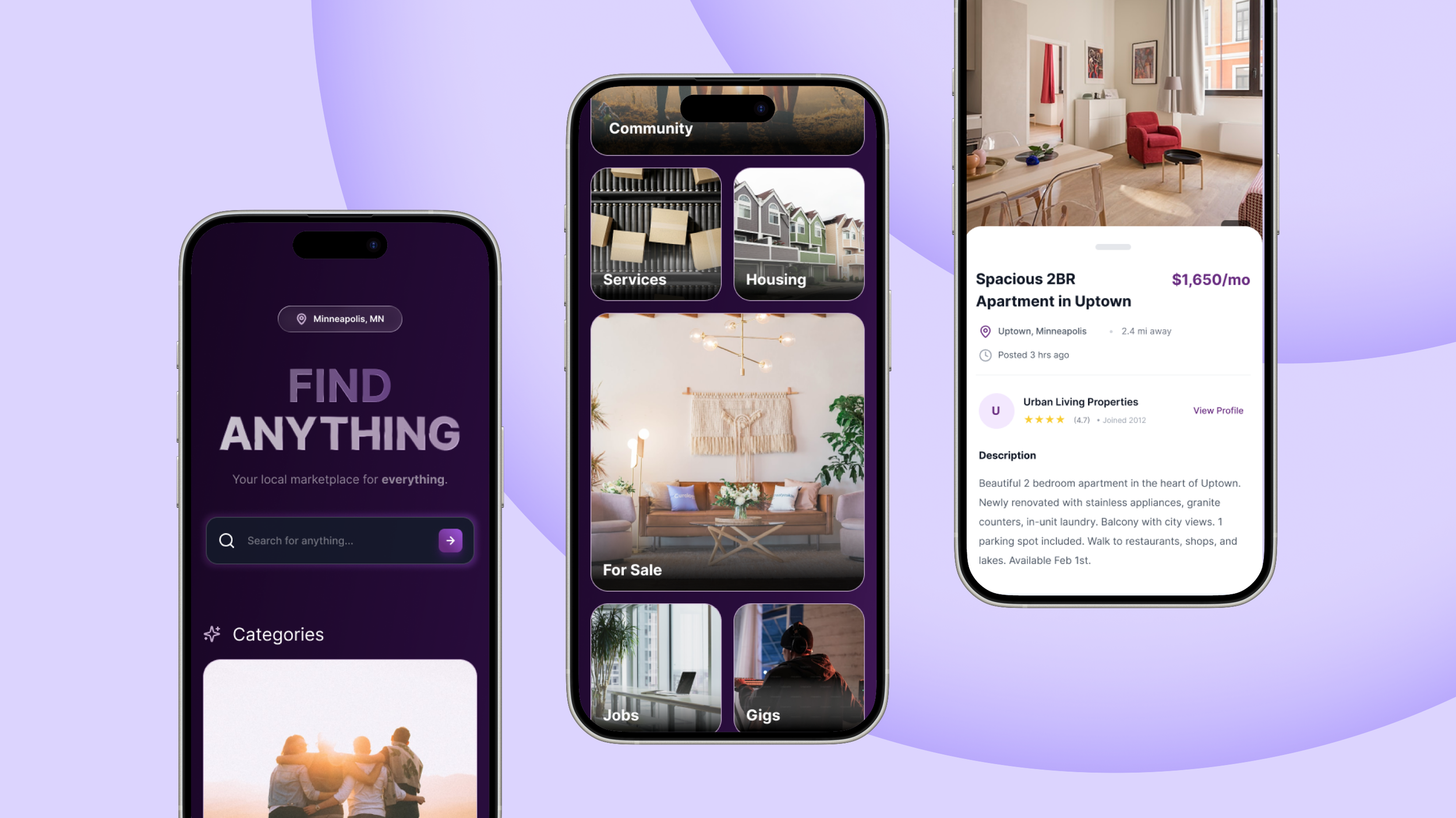
I explored how AI can enhance Craigslist’s marketplace experience by improving clarity, discovery, and decision-making while preserving the simplicity and trust that made it successful.
This project was a solo contract engagement completed for a design agency as part of a design challenge, focused on reimagining the Craigslist mobile marketplace experience. Craigslist remains one of the largest and most diverse peer-to-peer platforms in the world, spanning housing, jobs, services, and goods. Its scale and liquidity create immense value, but the current experience has not evolved alongside modern user expectations for mobile usability, clarity, and trust. As a result, users often face friction when browsing, evaluating listings, and making decisions, particularly without prior familiarity with the platform.
The goal of this project was not to reinvent Craigslist, but to modernize the experience in a way that makes its existing value more accessible, intuitive, and efficient for today’s users. This included improving information hierarchy, reducing cognitive load, and creating clearer pathways from discovery to action, while preserving the simplicity, neutrality, and low-friction model that define Craigslist’s success.
The resulting concept introduces a more structured, mobile-first experience that improves scanning, strengthens user confidence, and reduces friction in key flows such as browsing, search, and listing evaluation while maintaining the core principles that have allowed Craigslist to scale successfully over time.
MY ROLE
As the sole designer on this project, I led the end-to-end design process from problem framing through final visual execution. I leveraged AI tooling throughout the process to accelerate early ideation, explore interaction patterns, and rapidly iterate on layout and content structures. AI was used as a support system to enhance exploration and efficiency, not to dictate outcomes. Final decisions remained grounded in user behavior, marketplace dynamics, and product strategy.
PROJECT TIMELINE
This project was completed over the course of a short design engagement, focused on rapidly exploring and validating a modernized marketplace experience within the constraints of a 1-week design challenge timeline.
OPPORTUNITY
First and foremost, user expectations have evolved. What felt acceptable a decade ago no longer meets today’s standards for clarity, speed, and trust.
At the same time, the competitive landscape for online marketplaces has matured. Platforms like Facebook Marketplace, Whatnot, and eBay have evolved to meet those expectations by giving users key offerings like streamlined flows and a stronger perception of credibility.
All that to say, Craigslist still has strong brand equity and scale but the experience hasn’t evolved at the same pace. And that gap is where the opportunity lies.
Shifting Expectations
User expectations for marketplaces have shifted significantly toward mobile-first, visually driven experiences. Today, users expect to quickly scan listings through images, understand key details at a glance, and navigate seamlessly between browsing and decision-making. The tolerance for friction has decreased, especially on mobile where speed and clarity directly impact engagement.
Craigslist, while still highly functional, relies heavily on text-based structures and assumes a level of familiarity from its users. This creates a gap for new or less frequent users, who may struggle to quickly interpret listings or move efficiently through the experience. As expectations continue to evolve, improving clarity and reducing cognitive load becomes critical to maintaining usability.
Competitive Market
Modern marketplace platforms have evolved by optimizing for different strengths. Facebook Marketplace introduces an identity layer that builds trust through profiles and social context, while eBay emphasizes structured commerce with standardized listings, buyer protections, and consistent formatting. Platforms like Whatnot push even further, blending commerce with entertainment through live, highly engaging experiences.

PROBLEM
User expectations have evolved. What felt acceptable a decade ago no longer meets today’s standards for clarity, speed, and trust.
At the same time, the competitive landscape for online marketplaces has matured. Platforms like Facebook Marketplace, Whatnot, and eBay have evolved to meet those expectations by giving users key offerings like streamlined flows and a stronger perception of credibility.
Issues with the design can be boiled down to these three core issues:
Discovery within Craigslist’s marketplace feels overwhelming as is.
Evaluation is an inconsistent experience for users.
Trust on the app is implicit.
DESIGN PROCESS
This project focused on translating Craigslist’s core strengths into a more usable, modern mobile experience. The approach prioritized real-world constraints, rapid exploration, and clear decision-making by balancing thoughtful improvements with the need to preserve what already works at scale.
Framing the Marketplace
Rather than approaching Craigslist as an outdated product, I framed it as a system that has already optimized for scale, accessibility, and liquidity. Its success is driven by high participation and low friction, not visual polish; so, the goal was to improve usability without disrupting those dynamics.
This meant defining clear constraints early on. Core elements like chronological ordering, low-friction posting, and the open marketplace structure were intentionally preserved. These decisions grounded the work and ensured that improvements focused on clarity and usability, rather than introducing features that could compromise neutrality or reduce engagement.
AI in The Design Process
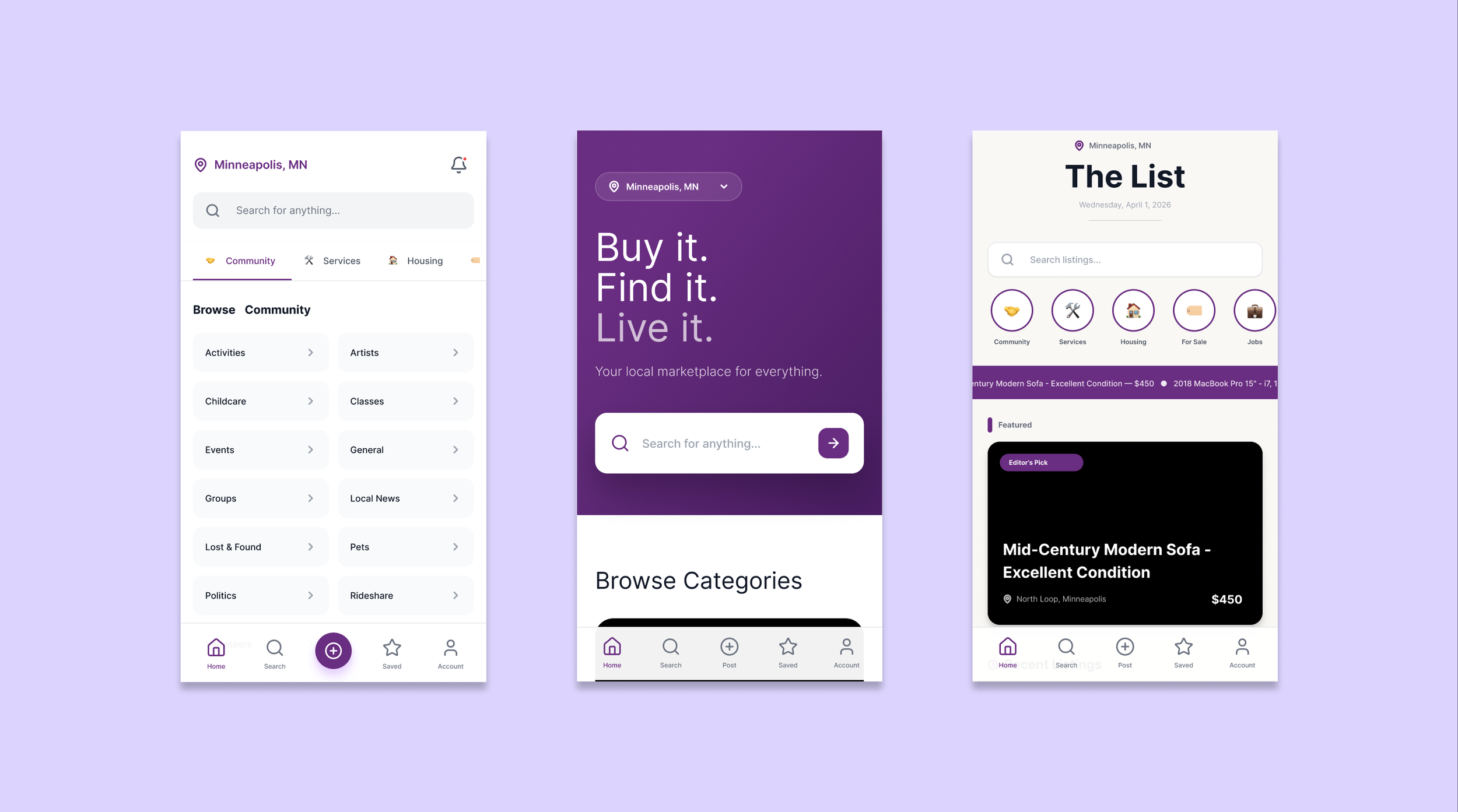
Early prototypes generated by three different AI design tools (v0, Figma Make, Magic Patterns).
AI tooling played a central role in how I approached this project. Instead of relying on static mockups, I used AI to rapidly generate variations of listing structures, simulate real-world content quality, and test how different layouts performed under inconsistent or incomplete data.
This allowed me to move beyond ideal scenarios and design for the realities of Craigslist’s marketplace. I was able to quickly explore a wider range of layout directions, stress test edge cases, and refine interaction patterns based on variability rather than assumptions. As a result, the process became more iterative and dynamic, enabling faster decision-making while ensuring the solutions were grounded in real-world usage.
Conversations with ChatGPT also helped validate many of my initial hypotheses by reinforcing them with relevant research and data-backed insights. This allowed me to move forward with greater confidence while ensuring decisions were grounded in broader industry patterns and user behavior.
Designing for Clarity, Speed & Structure
With constraints established and exploration accelerated through AI, the focus shifted to improving how users scan, evaluate, and act on listings. The primary goal was to reduce cognitive load by making information easier to interpret at a glance, without removing the density that power users rely on.
This involved introducing clearer hierarchy, more consistent metadata, and stronger visual grouping across key flows. Each decision was evaluated based on how effectively it improved scanning and shortened the path from discovery to action, which is ideal for helping users navigate the marketplace with greater speed and confidence.
SOLUTION
Craigslist already has the valued supply, reach, and long-standing trust.
A thoughtful refresh presents the rare opportunity to unlock growth for today’s users without changing the core marketplace model.


Home
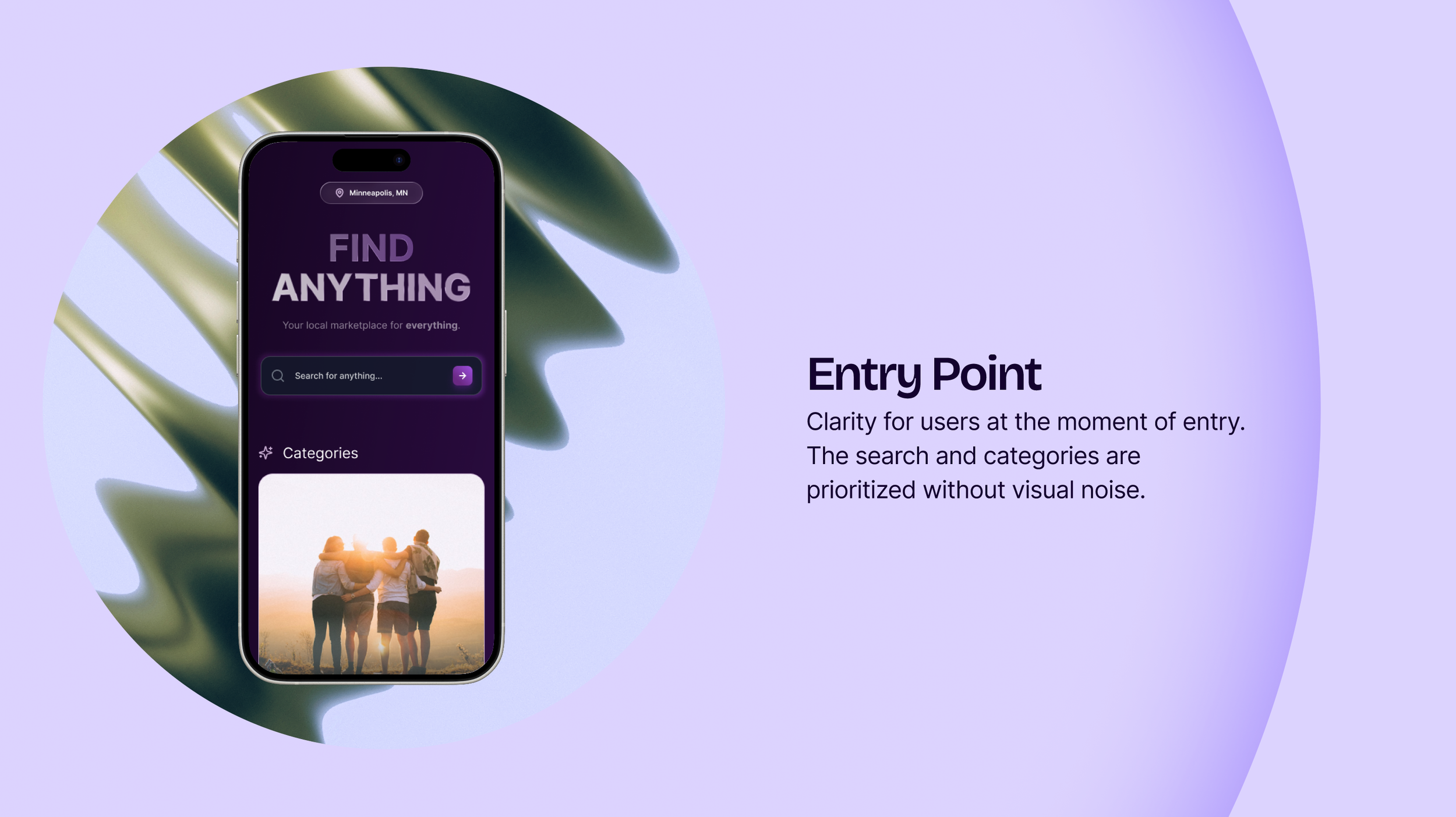
The home experience is designed to immediately align with user intent, prioritizing search as the primary entry point into the marketplace. Craigslist users typically arrive with a clear goal in mind, so surfacing search prominently reduces friction and allows users to quickly move toward relevant listings without unnecessary navigation.
Categories are structured to provide a clear secondary path for exploration, while maintaining simplicity and familiarity. The layout focuses on clarity over promotion. ensuring users can quickly understand where to go next without introducing unnecessary visual noise or competing elements.
Browsing
The browsing experience focuses on improving scanability while preserving the density that Craigslist users rely on. Listings are structured to highlight the most critical information (title, price, image, etc.). From there, users can quickly compare options without needing to open individual posts.
Rather than shifting to heavily visual card-based layouts, the design maintains a list-based approach that balances density with clarity. Subtle improvements in hierarchy and spacing make it easier to parse information at a glance, reducing cognitive load while still supporting efficient browsing at scale.
Search
Search is designed to feel predictable and responsive, reinforcing user control rather than attempting to over optimize results. The interface prioritizes clarity and speed, allowing users to refine queries and adjust filters without disrupting their flow.
AI is introduced lightly to support this experience, helping surface more relevant results and improve query interpretation without overriding user intent. The goal is to enhance discovery while maintaining the transparency and neutrality that users expect from Craigslist.
Listing Detail
The listing detail view is focused on helping users make faster, more confident decisions. Key information such as price, title, and images are prioritized, while supporting details are organized to reduce ambiguity and improve readability.
The layout emphasizes trust through clarity rather than added features. Doing so ensures that users can quickly assess the quality and legitimacy of a listing. By reducing friction in how information is presented, users can move more efficiently from evaluation to action.
IMPACT
While this project was conceptual, the design decisions were grounded in improving key moments across the marketplace experience particularly around discovery, evaluation, and decision-making.
By introducing clearer hierarchy, more structured listing layouts, and improved scanning patterns, the experience reduces the effort required to browse and compare listings. Users are able to identify relevant options more quickly, leading to faster decision-making and a more efficient path from intent to action.
The improvements also help make Craigslist more approachable for new or infrequent users. By reducing ambiguity and improving clarity across key flows, the experience lowers the barrier to entry by making it easier for users to engage with the marketplace without needing prior familiarity.
REFLECTION
This project was ultimately an exercise in balancing modernization with restraint. Craigslist’s success is rooted in its simplicity, neutrality, and scale, so the challenge was not to redesign the platform entirely, but to improve usability without disrupting the behaviors that make it work.
AI played a significant role, not as a visible feature layer, but as a tool for exploration and validation throughout the design process. By using AI to simulate real-world variability and rapidly iterate on layouts, I was able to design solutions that account for the inconsistencies inherent in an open marketplace.
It also reinforced the importance of designing for imperfect systems. Unlike highly structured platforms, Craigslist operates on user-generated content that is often incomplete or inconsistent. Designing within those constraints required a focus on flexibility, clarity, and adaptability, which ensures the experience performs well even when the data does not.